Simulation Coordinator Brings Realism to Health Education at STCC
True to Life

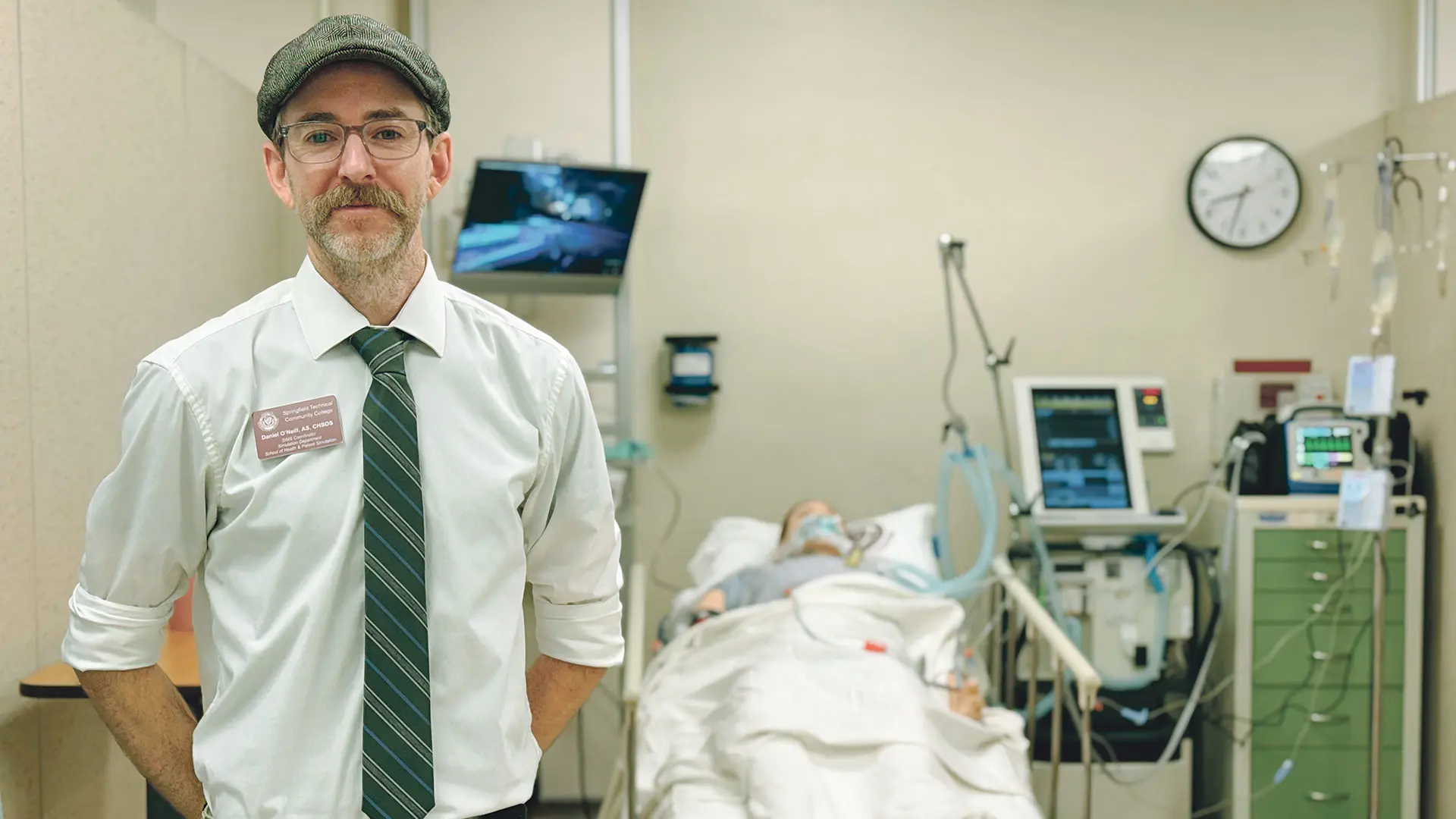
When healthcare program students in Springfield Technical Community College (STCC) step into a patient room at the SIMS Medical Center, they’re entering a high-tech learning environment designed to mirror the real world of healthcare.
Daniel O’Neill, Patient Simulation Information coordinator at the SIMS Medical Center, helps make those experiences possible.
“I’m one of two simulation coordinators,” said O’Neill, referring to himself and his colleague, Daniel Taibbi. “Together, we oversee a team of 15 employees who essentially build small movie sets so that students can practice high-fidelity healthcare simulations in a risk-free environment.”
The SIMS Medical Center hosts about 16,000 simulated experiences each year for students enrolled in 26 degree and certificate programs. O’Neill and his team ensure each scenario runs smoothly and meets national accreditation standards.
Accreditation by the Society for Simulation in Healthcare is no small point of pride. Last year, SIMS Medical Center earned this designation, making it one of only a few simulation centers in Massachusetts to reach that level of recognition, which is considered the gold standard in healthcare simulation and serves as a benchmark for excellence in patient simulation.
“These patients can blink, breathe, cry, respond to pain, and more. With the exception of walking out of the bed, they can do everything a human patient can.”
The center’s fleet of approximately 120 high-fidelity robotic patients allows students to practice their clinical skills in a realistic but safe setting.
“These patients can blink, breathe, cry, respond to pain, and more,” O’Neill said. “With the exception of walking out of the bed, they can do everything a human patient can.”
Virtual Reality
Simulation offers a powerful advantage in healthcare education. Studies show students retain up to 80% of knowledge gained through simulated experiences. STCC graduates also complete their clinical onboarding more quickly than peers from other institutions, O’Neill said, because they arrive with extensive hands-on practice.
Faculty play a key role in the process. Professors define learning objectives, and the SIMS team brings those objectives to life. “It’s a deep partnership,” he said. “We make sure what we’re setting up aligns with their vision for student learning.”
O’Neill spends a growing portion of his time in training and development meetings with faculty, helping them understand and use emerging technologies to enhance student learning.
Since 2020, STCC has expanded its innovation lab, introducing virtual reality to multiple health programs. Students can step into immersive scenarios or even view care from a patient’s perspective.
“AI lets us create more realistic and dynamic encounters that reflect cultural, religious, and social diversity. It prepares students to care for people who aren’t just like themselves.”
One simulation left a lasting impact on a 6-foot-5 student who experienced what it was like to lie in a hospital bed with a tall doctor standing over him. “He took the headset off and said, ‘I never realized how intimidating that feels,’” O’Neill recalled. “From that moment on, he started sitting down when talking to patients. That’s empathy building — and it’s just as important as any clinical skill.”
The SIMS Medical Center is also embracing artificial intelligence (AI), which allows for more authentic patient interactions. “AI lets us create more realistic and dynamic encounters that reflect cultural, religious, and social diversity,” O’Neill said. “It prepares students to care for people who aren’t just like themselves.”
In recognition of his contributions, O’Neill received the 2025 Individual Contributor Award/Star Award, an annual honor presented to an employee who demonstrates outstanding dedication and signature contributions to the college community.
STCC President John Cook praised O’Neill’s impact on the SIMS Medical Center and on students preparing for healthcare careers.
“What a unique skill set,” he said. “Dan, we are so grateful for all that you contribute to a very high-profile asset for the college. Our SIMS Medical Center, with the talent of Dan along with staff and faculty colleagues, provides a national model for future-now healthcare in higher education.”
Patient Approach
O’Neill’s path to STCC wasn’t traditional. He previously worked in restaurant management, at Apple as an educator, in event production, and even as a photographer for Lego. He joined STCC nearly nine years ago, first as a part-time simulation operator.
“I’ve always loved building teams and improving systems,” he said. “This role lets me do that while helping students prepare for meaningful careers.”
Prospective students experienced STCC’s SIMS Medical Center during a recent Career Exploration Night, where live simulations showcased the technology and immersive learning opportunities available.
“It’s the best night of the year to see what happens here,” O’Neill said. “Our goal is to give students the skills and confidence they need before they ever step into a hospital.”