
Veterans’ Home Takes Shape in Holyoke
View to the Future


The new Veterans’ Home at Holyoke won’t be welcoming its first residents for another nine months or so, but the gleaming, $500 million structure on a hill overlooking the Paper City has already captured the imagination of the region.
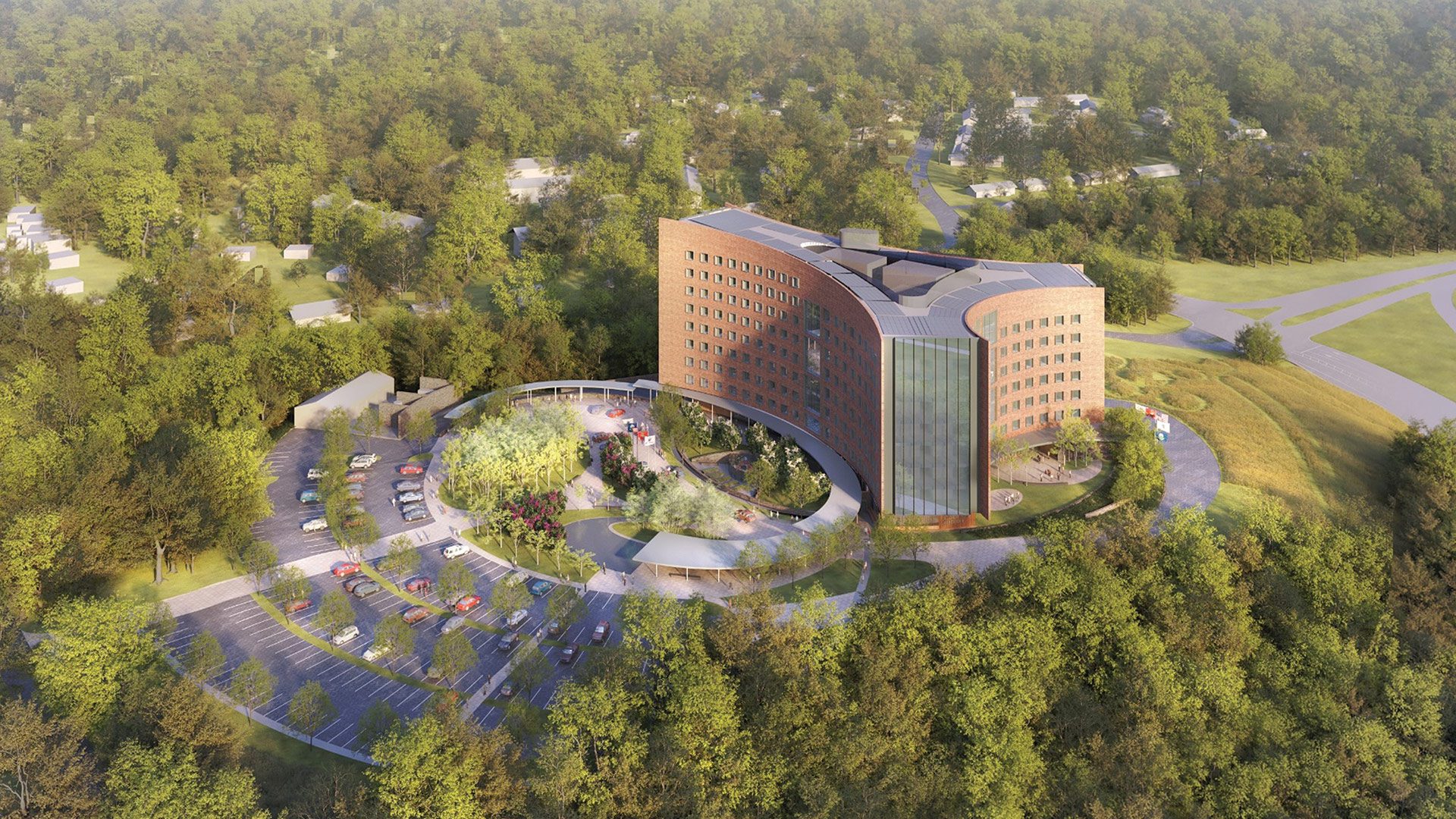
Highly visible to motorists on I-91 and to residents of Holyoke as well, the nine-story, Y-shaped building — a design one of those on the construction team said was inspired by the tricorn hats worn by Revolutionary War soldiers — serves as both a reminder of the tragedy that occurred during the early days of COVID at the structure it will replace, as well as a symbol of the state’s commitment to modernize the facility in the wake of that calamity.
Michael Lazo, executive director of the home, was a member of the National Guard unit that was dispatched to what was then called the Soldiers’ Home in late March 2020 amid a deepening crisis that would eventually take the lives of 76 residents in one of the nation’s worst COVID-19 outbreaks in a long-term care facility.
“I remember first walking in and not knowing what the heck we were walking into,” he recalled, noting that he arrived at the site on March 30, three days after the facility’s leadership made the fateful decision to combine two locked dementia units into a single undersized unit, precipitating the rapid spread of COVID. “Everything looked completely normal; you wouldn’t think anything was going on.”
Lazo would later be offered a full-time COO position at the home and eventually would be named interim director by the board of trustees and then the state. Today, he oversees all operations at the home while also preparing for the opening of the new facility, which will be called the Veterans’ Home, rather than the Soldiers’ Home, in deference to the veterans who served in other branches of the military.
“I think it just came down to money; other priorities probably stepped in and took precedence, so some of the funding this building should have received went elsewhere.”
“Especially the Marines — they’ve never liked Soldiers’ Home,” he joked, adding that he’s also finding time these days to offer tours of the building in progress — to staff, a few elected officials (more of those are scheduled to go through in the days and weeks to come), and a few media members.
BusinessWest was afforded such a tour late last month. As noted, the facility is several months from welcoming its first residents, and only a few floors are even approaching completion. But even at this early stage, it’s apparent that the complex itself is a work of art — one that will integrate the building with the surrounding landscape — and the structure will be state-of-the-art.
Indeed, building systems, designed to LEED Gold certification, include geothermal heating and cooling and facilities that are net-zero energy ready, a high-efficiency exterior envelope with triple-glazed windows, and natural ventilation. The foundation and outdoor retaining wall are made up of Goshen stone. Amenities include a great room, chapel, memory care floor, 40-person adult day health program, dental suite, salon, hobby room, four gardens, and a central kitchen.

Overall, said Lazo, the facility, complete with its curved brick walls, takes the form of three shells that overlap to define three inpatient neighborhoods, each of which benefits from light and views. A typical resident floor will be comprised of three ‘houses’ with 12 beds per house, nursing support, and community spaces, including dining, living, and den. A large garden anchors the complex, and in between wings are smaller, dedicated gardens.
For this issue, BusinessWest takes an early look at what will be one of the biggest stories of 2026, the long-awaited opening of the Veterans’ Home and the start of a new era of service to those who have served their country.
Learning Curves
Lazo said he wasn’t around, so he can only speculate and reflect on what he’s been told over the years.
But he believes that, in the years preceding the COVID tragedy, the state “simply forgot about” the Soldiers’ Home in Holyoke.
One of his predecessors in the director’s role resigned over what amounted to indifference on the state’s part concerning the facility, he said, adding that, in the decades preceding the COVID tragedy, there was little investment in the facility, and little oversight as well — and it showed, especially in the broad realm of preventive maintenance, or the lack thereof.
“I think it just came down to money; other priorities probably stepped in and took precedence, so some of the funding this building should have received went elsewhere,” he said, adding, again, that he was just speculating.
The tragic events in the early days of COVID and the investigations that followed certainly put the facility front of mind, triggering significant reforms to the state’s oversight of its veterans’ homes, he said, adding that what emerged were plans for a new long-term care facility that would serve more veterans and provide them with state-of-the-art amenities.

There was some talk of expanding and modernizing the current facility, he noted, but building new emerged as the more practical option. And while another site may have been considered, the state became committed to keeping the facility at its prominent hilltop location, a popular decision, but one that has presented challenges to the builders of the new facility as they squeezed it onto the site — and will present more to those that will tear down the current home.
Indeed, when finished, one corner of the new home will be just 10 feet from the current facility, which will eventually be used for parking and a garden area.
The new facility will house 234 residents, almost double the current population of 128. There will be 212 single-occupancy bedrooms and 11 double-occupancy bedrooms in those three neighborhoods mentioned earlier: North House, East House, and West House.
These neighborhoods, which will house veterans of several different conflicts (including World War II) and peacetime periods as well, represent substantial improvements over current facilities, said Lazo, especially in the realms of privacy and dignity of residents — each unit has a private bath and showers, while the current facility features common baths — as well as activities and things to do.
“Each veteran has a good-sized room, and there’s plenty of activity space, both on the first floor as well as in each individual unit.”
“The space for veterans is great,” Lazo said. “Each veteran has a good-sized room, and there’s plenty of activity space, both on the first floor as well as in each individual unit. Each floor will have a different activity; we’ll have an exercise bike or some small weights on one floor and arts supplies on the next floor, so veterans will be able to move about the building to do whatever activity they’re interested in at that time.”
And then, there will be the so-called great room, which will host large gatherings such as holiday activities and Super Bowl watch parties, he said, noting that it will be equipped with a 90-inch television.
Tour de Force
As BusinessWest toured the second floor of the new facility and a 30-unit memory care unit under construction there, we were directed to one of the 12- by 16-foot resident rooms, complete with a large window, spacious bath and shower area, space where a 55-inch television will go, built-in storage and shelving units, a desk, and other accommodations.
As the tour continued, Tim Senecal, general supervisor with Commodore Walsh Holyoke, a joint venture comprised of Commodore Builders LLC and Walsh Brothers Inc., referenced common den areas with huge windows and sweeping views of the surrounding area, the facility’s chapel, administrative space, and the location that will become the great room.

“The higher you go, the better the views get, obviously,” said Senecal, who talked as he walked — about everything from those views to the many challenges involved with construction, from excavating for the foundation to the brickwork, made more difficult by the curved nature of the structure, to the Goshen stone retaining wall.
Some of the building’s design elements were borrowed from the new Veterans’ Home at Chelsea, a smaller facility (154 beds) that opened last year, said Lazo, adding that the overall design is distinct, with input from the staff at the current home.
As noted earlier, the first residents will not move into the new home until next September; the first group of 24 will be moved from the fourth floor of the current facility to the third floor of the new one. After that, if all goes well, veterans will move in roughly 20 at a time, with the memory care residents being the last to move. Lazo said his goal is to have all residents moved by February 2027.
That 16-month period will be the most challenging for the staff members at the facility because they will be managing two facilities at the same time, he added, noting that final project completion, including the demolition of the current home, is slated for mid-2028.
As he talked about that teardown and the logistical challenges it will present, Lazo joked that it’s likely that several staff members wouldn’t mind helping with that effort and send the tired, tragedy-scarred property into history.
But that will also be a sad time, he said, noting that several generations from the same families, including his own, lived and died in that home.
The new home, born in many ways from that tragedy of nearly six years ago, will no doubt create its own memories and its own history.
But right now, it’s creating excitement for the next chapter in the story of this fabled property — and with good reason.